// Concepts
Proposal Types
Every kind of proposal, what it does when it passes and which rules it runs under.
A proposal says what it does, and the ledger does exactly that if it passes. There are seven types. Two are Decisions and choices, which run under a rule their proposer sets. The other five are Changes to the DAO, which run under the DAO's voting rules.
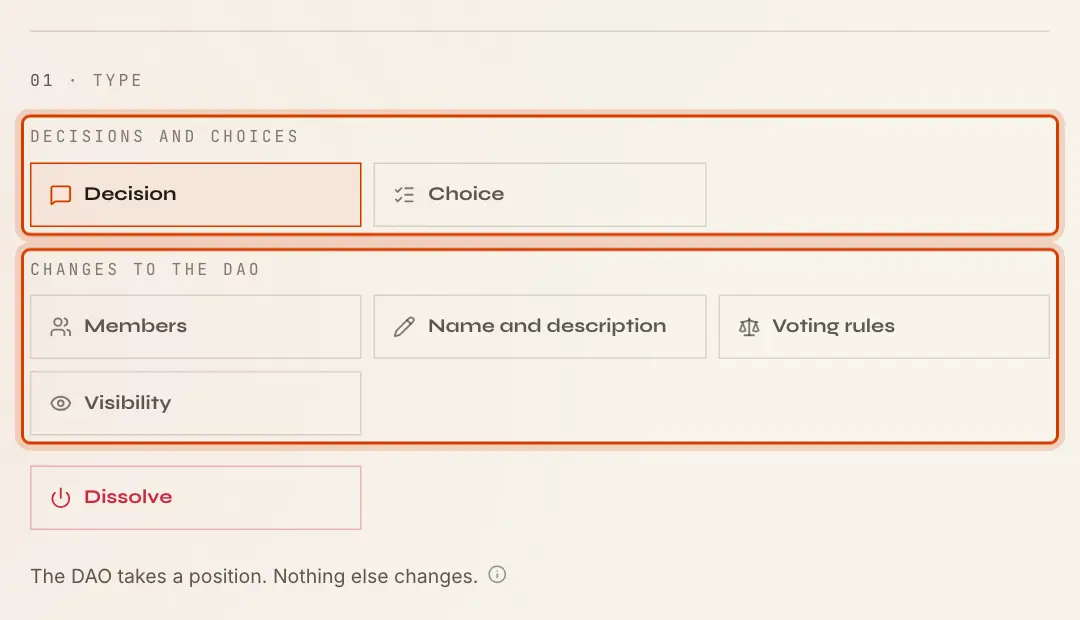
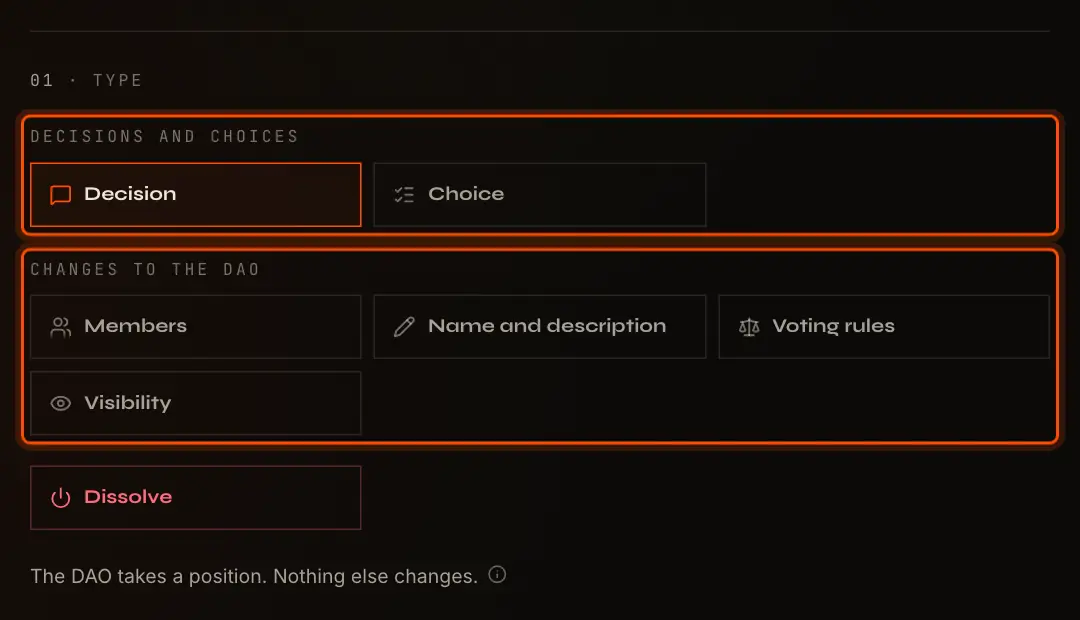
| Type | If it passes |
|---|---|
| Decision | The DAO's position is on record. |
| Choice | The chosen option or options are on record. |
| Members / Shares | Parties join, leave or change units. |
| Name and description | The DAO gets a new name, description or picture. |
| Voting rules | Changes to the DAO pass by new rules. |
| Visibility | The DAO becomes public, or private again. |
| Dissolve | The DAO closes for good. |
Decision
A yes-or-no question: approve a budget, adopt a policy, give a mandate. Members vote Yes, No or Abstain. If it passes, the outcome is recorded on the ledger. Nothing else changes, so its badge stays Passed.
Choice
The DAO picks from 2 to 10 options, each up to 80 characters and all different. A member can also abstain, which takes part without picking.
One Pick
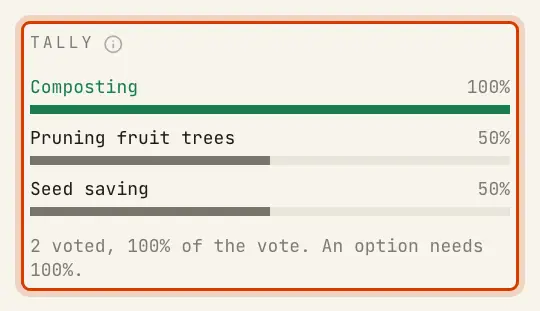
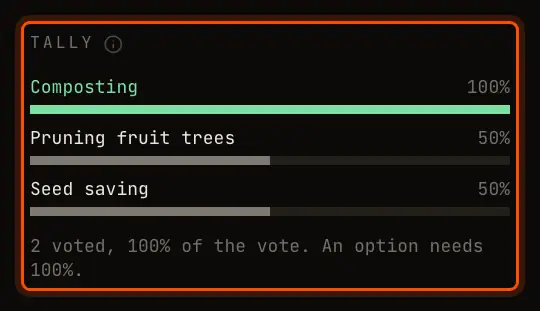
Each member picks one option. The option with the most units wins if it meets the rule the way a yes would, and no other option is level with it. A tie at the top decides nothing, and the proposal fails.
Example: 10 members, Majority of the vote. Options A, B and C get 6, 3 and 1 votes: A has more than half of the whole vote, so A is chosen. With 4, 4 and 2, nothing is chosen: A and B are tied, and neither has more than half anyway.
Where the basis is Votes cast, the leader is measured against all the votes for options; abstentions are left out.
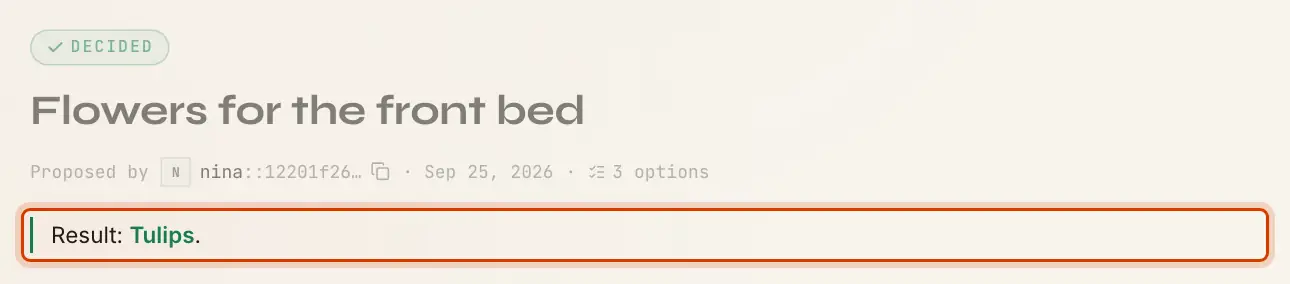
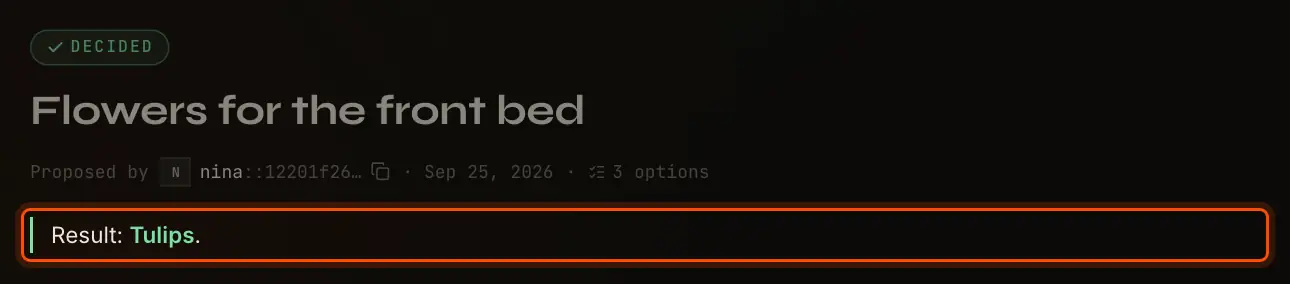
Several Picks
With Several options on, each member ticks any number of options. Each option is measured against
the rule on its own, and every option that meets it is chosen. If none does, the proposal fails. The
proposal list shows such a choice as 3 options, pick any.
Where the basis is Votes cast, each option is measured against the units of the ballots that picked anything, since one ballot can back several options.
Example: 10 members, Majority of the vote, three candidates. They get 7, 6 and 4 votes. The first two each have more than half of the whole vote, so both are chosen.
Members and Shares
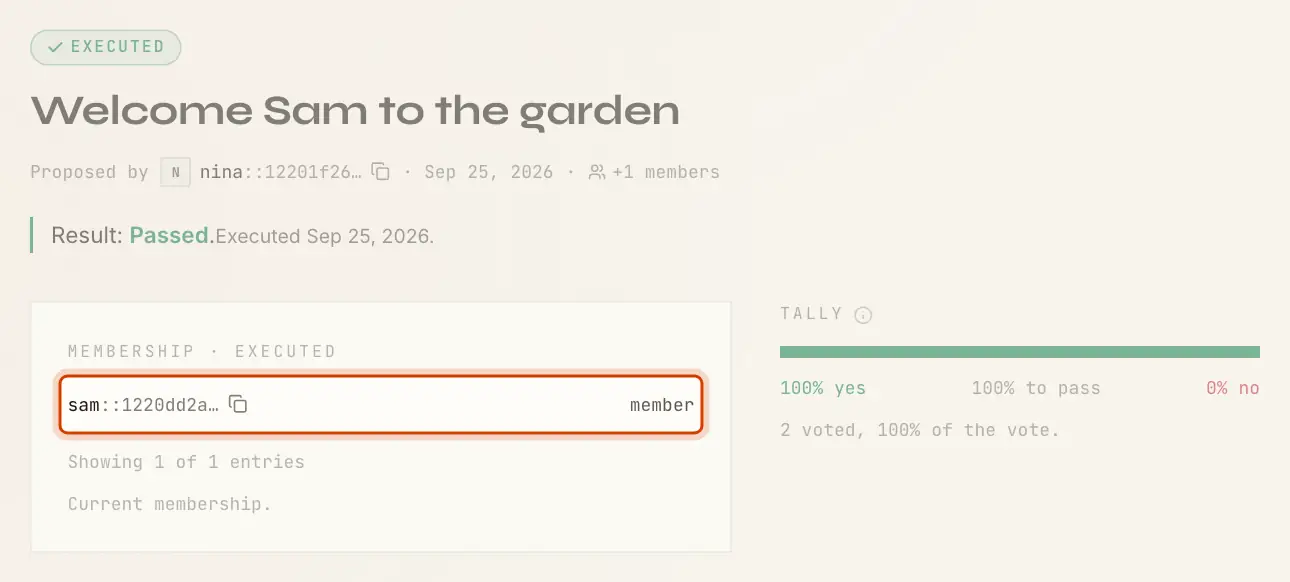
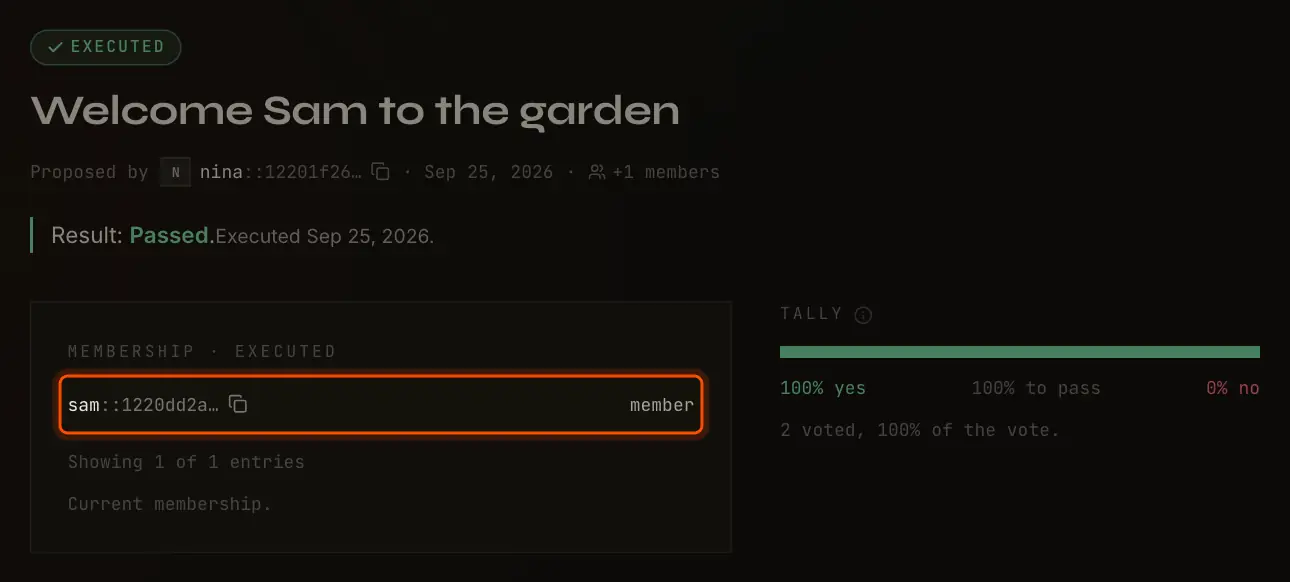
In a DAO by membership this type is Members; in a DAO by shares, Shares. The editor starts from today's table. You add parties, remove members or change units, and only what changes is put to the vote.
- Each party you add must already be registered with SyncVotes on this network.
- In a DAO by membership, each member holds exactly 1 unit.
- In a DAO by shares, units are whole numbers, and 0 means the member leaves.
- The DAO must keep at least one member with units.
- One proposal can change up to 2,000 parties. It is executed in batches of 200.
- Two proposals cannot change the same party at once. The second is refused, naming the first, until the first has failed or been executed.
Who Votes on What
A proposal's electorate is fixed the moment it is made: the members and units of that moment. So:
- Someone who joins later does not vote on proposals made before they joined.
- A member whose units change does not vote on proposals made before the change. A ballot they cast before it still counts, with the units they had.
- A member who leaves while a proposal is open can no longer vote on it. Under the whole vote their units still count toward the total, as if they had voted no.
On a proposal made before you joined or before your units changed, the vote box says or
Name and Description
Changes the DAO's name (2 to 60 characters), description (Markdown, up to 10,000 characters, may
be cleared) and picture (an https link, or none). The fields start from the current values.
On the proposal page a card shows the name, picture and description as they will be.
Voting Rules
Sets the ballot and rule for every change to the DAO proposed from then on. It passes under the current voting rules; proposals already open keep theirs. See Voting Rules.
Visibility
Makes a private DAO public, or a public one private. See Public and Private DAOs.
Dissolve
Closes the DAO permanently. A passed dissolution does not take effect while anything else in the DAO is unfinished: it waits until every other open proposal is decided and every passed change is carried out. Meanwhile its page says , naming what it waits for. Meanwhile nothing new can be proposed: the DAO page says where New proposal was. Then:
- nothing more can be proposed in the DAO;
- the DAO's page no longer opens (it says ), and the DAO leaves My DAOs and Public DAOs;
- its proposals, ballots and comments stay on the ledger, and members can still open a proposal by its link;
- what is left of its balance is lost; nobody gets it back.
No Cancelling
Nobody can edit, withdraw or cancel a proposal, its proposer included. A proposal you no longer want runs to its deadline; members can vote it down.