// Introduction
What Is SyncVotes
DAOs, proposals and votes on the Canton Network, signed by keys only their members hold.
SyncVotes is a governance app on the Canton Network. You create a DAO, put proposals to its members and vote on them. Every DAO, proposal and ballot is a Daml contract on the ledger, and every transaction you make is signed by a key that stays in your browser.
Who It Is For
- Groups where each member has one vote, such as a committee, a club or a collective. These DAOs vote By membership.
- Organizations where votes follow ownership, such as a company, a fund or a partnership. These DAOs vote By shares: members hold units of the vote (40 of 100, for example).
- Anyone who wants a decision on record, rather than in a chat poll or a spreadsheet.
A DAO Run by Nobody
A DAO has no administrator. Everything that changes it is decided by a vote of its members, and the app then executes it on the ledger:
| What changes | Proposal type |
|---|---|
| Who is in it, and with how many units | Members or Shares |
| Its name, description and picture | Name and description |
| How it votes on changes | Voting rules |
| Who can read it | Visibility |
| Whether it goes on | Dissolve |
The person who creates a DAO carries the Creator tag: after creation they propose and vote like any other member. Their signature is on the DAO beside the app's, so the app cannot change a DAO without them. Nobody edits a DAO by hand, and nobody can withdraw a proposal once it is made.
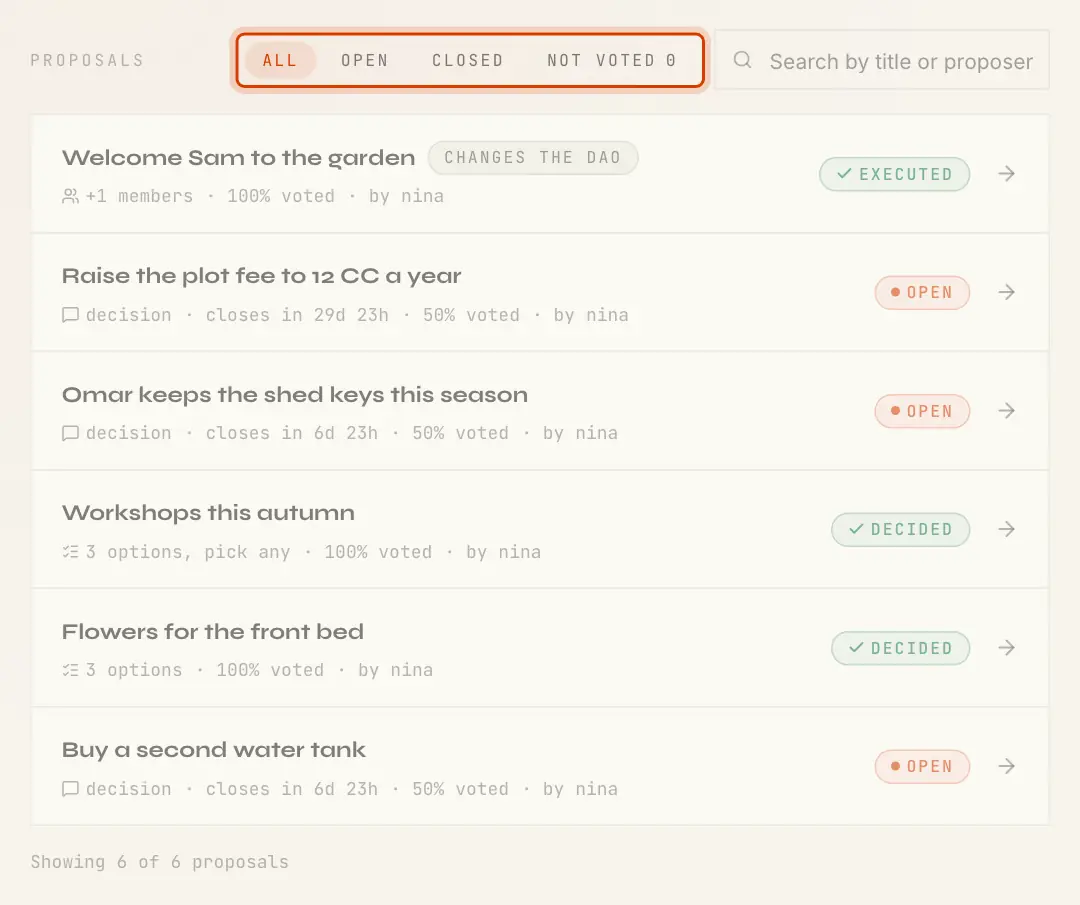
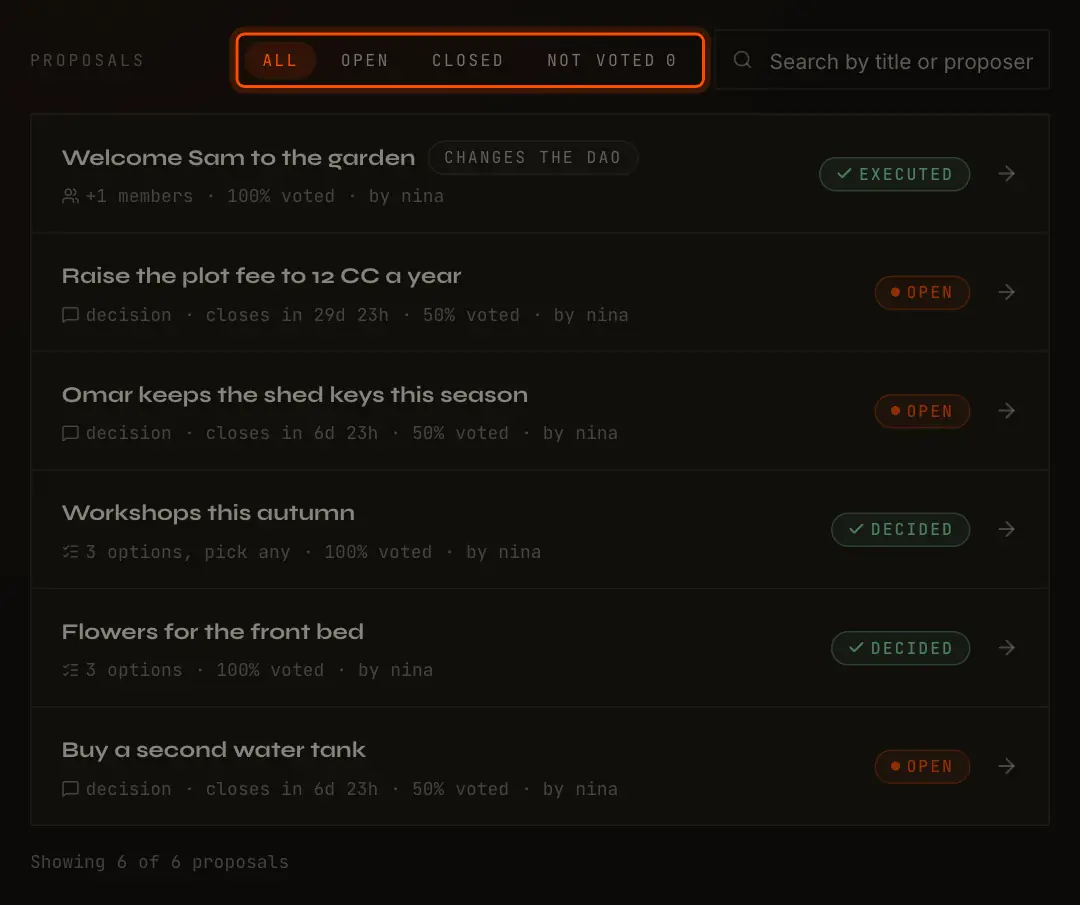
How a Vote Works
- A member creates a proposal. The vote opens the moment they sign it.
- Members vote, each ballot signed with the member's own key.
- The app hands the ballots to the ledger in batches. The ledger checks each one and keeps the count on the proposal.
- The proposal is decided as soon as the outcome can no longer change, or at the deadline, depending on its rule.
- If it passed and changes the DAO, the app executes the change with the DAO's authority.
The app can delay a result or make it fail, and under some rules tip it, but it cannot forge a ballot. Trust Model lists exactly what it can and cannot do.
What Stays on Your Device
Your key is made from a 12-word recovery phrase in your browser and never reaches the server. The server prepares each transaction, your browser checks it and signs it, and the server submits it with your signature. On the ledger you are a party, hosted on the app's validator, that only your key can sign for. See Keys and Parties. That validator also holds every DAO it runs, private ones included; a community that wants its DAOs on its own validator can run SyncVotes there: Self-Hosting.
What It Costs
Every transaction uses Canton network traffic, paid in Canton Coin (CC). Where a network charges for it, you or your DAO top up a balance and each transaction is charged to it. On DevNet and TestNet SyncVotes charges nothing for now, and the app says so where a balance would be. See Balances and Traffic.
Three Networks
| Network | Site |
|---|---|
| MainNet | syncvotes.com |
| TestNet | test.syncvotes.com |
| DevNet | dev.syncvotes.com |
Each is a site of its own, with its own parties and DAOs; nothing carries over. See Networks.
Open Source
The code, including the Daml model the ledger enforces, is on GitHub. The Build link in the footer opens /version, which names the commit the site runs
and the ID of its Daml package.