// Concepts
Voting Rules
What it takes for a proposal to pass, with worked examples.
A rule says what it takes for a proposal to pass. Every proposal carries its rule from the moment it is made, and the ledger applies it when it counts. All figures are in units of the vote: one per member in a DAO by membership, the member's holding in a DAO by shares.
Which Rule Applies
| Proposal | Rule | Set by |
|---|---|---|
| Changes to the DAO: members and shares, name, description and picture, voting rules, visibility, dissolution | The DAO's voting rules | The creator at creation, then the members by a Voting rules proposal |
| Decisions and choices | The proposer's rule | Whoever makes the proposal |
A decision or a choice changes nothing on the ledger beyond its own record, so its proposer may choose how it passes. A change to the DAO always runs under the DAO's voting rules. A proposer cannot make one easier to pass.
The Settings
| Setting | Choices | What it does |
|---|---|---|
| Basis | Whole vote, Votes cast | What yes is measured against. |
| Threshold | More than half, Fraction, Percentage | How much of the basis yes must reach. |
| Quorum | 0 to 100% | How much of the whole vote must take part. 0 means no quorum. |
| Settle early | On or off | Decide as soon as the remaining votes cannot change the outcome. |
| Votes may change | On or off | Let members vote again until the deadline. Turns settling early off. |
| Secret ballot | On or off | Show each member only their own vote. |
| Voting period | 1 to 90 days | How long the vote is open, from the moment the proposal is signed. |
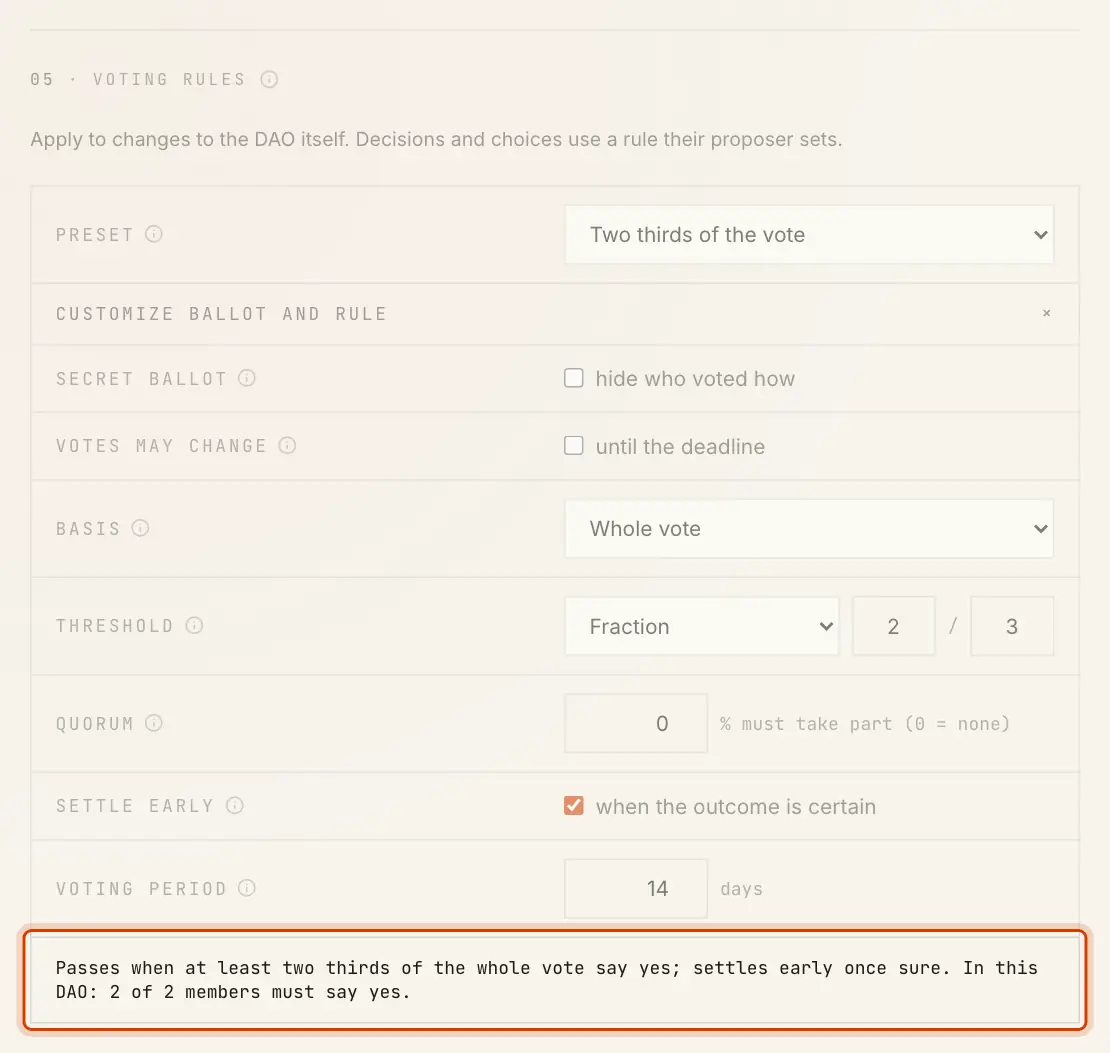
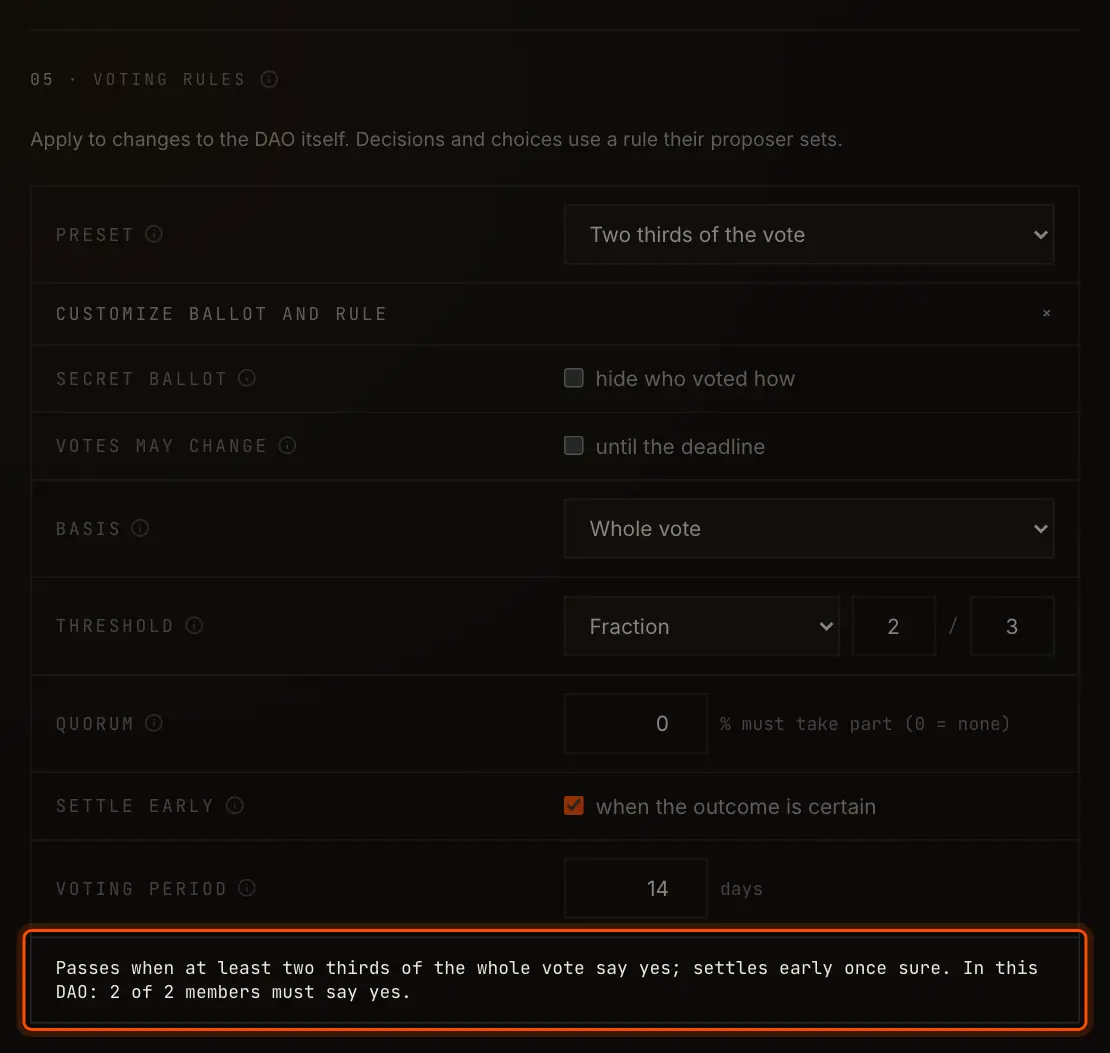
The settings sit under Preset, behind Customize ballot and rule, on the Create
DAO page, on a Voting rules proposal and on every decision or choice. The line underneath works
the rule out as the form stands, for example In this DAO: 4 of 5 members must say yes.
Basis: Whole Vote or Votes Cast
The whole vote is every unit that existed when the proposal was made. Measured against it, a member who does not vote, or abstains, counts the same as a no.
Votes cast counts only yes and no. Members who stay away or abstain do not count either way, so a small turnout can decide. Pair this basis with a quorum.
Example: a DAO of 100 units. 30 units take part: 16 yes, 10 no, 4 abstain. The threshold is more than half.
| Basis | Yes needs | Result |
|---|---|---|
| Whole vote | more than 50 of 100 | Fails: 16 is not enough |
| Votes cast | more than 13 of 26 (yes plus no) | Passes, if the quorum is 30% or less |
Threshold
- More than half means strictly over 50%. Of 100 units, 51 passes and 50 does not. Of 5 members, 3 pass.
- Fraction means at least that fraction, rounded up. Two thirds of 5 members is 4 (3.33 rounded up); two thirds of 3 members is 2.
- Percentage means at least that percentage, rounded up. 67% of 3 members is 3, since 2 is only 66.7%.
Two thirds and 67% differ in small DAOs, as the last example shows. Use a fraction when you mean one. A fraction can have a denominator up to 100 and cannot exceed 1.
Quorum
The quorum is the share of the whole vote that must take part: yes, no and abstentions all count toward it. If it is not met when the proposal is decided, the proposal fails, whatever the yes count.
Example: under Majority of votes cast (quorum 25%) in a DAO of 100 units, 15 units vote yes
and 5 vote no. That is 75% yes, but only 20% of the vote took part, so the proposal fails. The tally
says quorum not met: 20% of the vote took part, 25% needed.
Settle Early
With settling early on, the proposal is decided the moment the ballots still to come cannot change the outcome. It passes as soon as yes is sure to meet the rule, and fails as soon as yes can no longer meet it even if everyone left votes yes.
Example: a DAO of 5 members under Two thirds of the vote (4 yes needed).
- After 4 yes votes, it passes at once. The fifth vote cannot change that.
- After 2 no votes, it fails at once. At most 3 yes votes remain possible, and 4 are needed.
With settling early off, the proposal is decided at the deadline by whatever was cast. Under Votes cast, an early result needs yes to be sure even if every member still to vote says no, so most such proposals are decided at the deadline.
Votes May Change
With this on, a member can vote again until the deadline, and the new ballot replaces the old one. Because any ballot can still change, nothing is counted before the deadline and the proposal cannot settle early. The app turns settling early off when you turn this on, and the ledger refuses a rule with both.
With it off, a member's first ballot is final.
Secret Ballot
The page shows every member the totals, and each member only their own vote. The ballots are still on the ledger, and the app sees them because it counts them. See Secret Ballots.
Presets
A preset sets the basis, threshold and quorum at once. Changing any of those by hand switches the preset to Custom.
| Preset | Basis | Threshold | Quorum | 5 members need |
|---|---|---|---|---|
| Majority of the vote | Whole vote | More than half | None | 3 yes |
| Majority of votes cast | Votes cast | More than half | 25% | More yes than no, with at least 2 taking part |
| Two thirds of the vote | Whole vote | 2/3 | None | 4 yes |
| Unanimous | Whole vote | 100% | None | 5 yes |
The defaults are:
- DAO voting rules: Two thirds of the vote, open ballot, votes final once cast, settling early, 14 days.
- A decision or choice: starts from Majority of the vote, open ballot, votes final once cast, settling early, 7 days. The proposer can change any of it.
Changing the DAO's Voting Rules
A Voting rules proposal carries the new ballot and rule. It passes under the rules in force, not the ones it proposes. Once executed, the new rules apply to every change to the DAO proposed after that. Proposals already open keep the rule they opened with.